


Reveal the Break Points That Destroy M&A Value
People Impact Analytics® gives you a predictive, people-driven view of where integrations and transformations succeed, fail, or start eroding deal value – early enough to act.
Why Change Fails So Often
According to Deloitte, “people and culture issues are the most common reasons of failing integrations.” More broadly, a Bain & Company study shows that “88% of business transformations fail to achieve their original ambitions,” and that “the strongest predictor of success is how well the company retains, develops, and acquires the right talent and capabilities.”
People are clearly at the center of the challenge. But when change fails, the consequences go far beyond declining employee experience or well-being. Failed integrations and transformations are ultimately measured in lost value, missed synergies, and significant financial damage.
The Financial Impact of Failed Integrations Escalates in Layers
Almost every M&A integration triggers strong emotional responses among employees, which directly affect behavior. Even in otherwise well-managed integrations, this typically leads to declining productivity and increased attrition. The resulting cost leakage is immediate and measurable, commonly $10–50k per each employee, and significantly higher for critical roles. These are the visible, direct people-related costs most organizations recognize.
But these direct costs are often only the first layer of value erosion. People and culture friction frequently delays or prevents synergy realization, weakens operational momentum, and erodes goodwill – easily destroying 10-30% of deal value when it occurs.
One of the most concerning consequences of people-related issues is delayed synergy realization. The premiums paid in most acquisitions require synergies to justify the investment – the goal of making one plus one equal more than two. These expected synergies may come from cost reductions, revenue growth, or less tangible benefits such as a stronger market position. What matters is not only the ultimate value of these synergies but also how quickly they are realized. Synergies which are delayed become less likely to materialize at all. Since realizing synergies typically requires change, people play a decisive role in determining both the extent and speed of synergy realization.
In more severe cases, integration failures undermine the standalone performance of the target. In rare but very real scenarios, they escalate into buyer repricing, where total value destruction meets or greatly exceeds the original deal value.
Across these escalating risk levels, based on numerous studies, it is reasonable to assume that around half of the damage is fully or partially driven by people and culture factors, making them one of the most critical, and most preventable, sources of financial risk in M&A.
A Simple, Scalable Process for High-Stakes Change
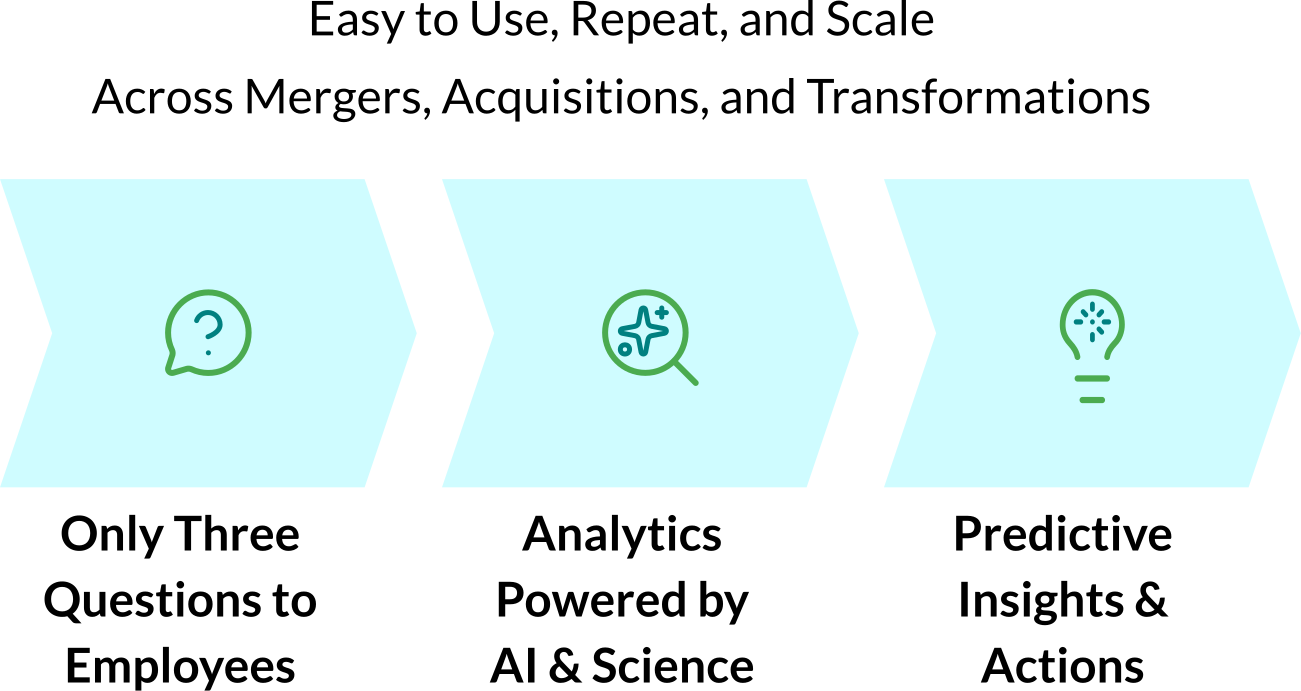
People Impact Analytics® is not a one-off analysis or a heavy consulting project. It is a standardized, intelligent process designed to be easy to use, repeat, and scale across mergers, acquisitions, and transformations of different sizes. The analytics supports M&A end-to-end, from valuation, through due diligence, between signing and closing, in post-close integration and value realization.
The process follows three clear phases:
- Ask only three intuitive questions from employees
- Analyze the data with AI and science-based algorithms
- Deliver predictive insights and focused action recommendations
The goal is simple: see the break points early and act before problems escalate.
Three Questions That Matter
Collecting the data does not burden people. Traditional long surveys are not needed.
People Impact Analytics® is based on only three questions:
- Emotions triggered by the integration or transformation (1-2 selections from a validated scientific model of 20 emotions)
- Emotional intensity (mild, moderate, or strong)
- The reasons behind those emotions (open-ended)
Optional background (demographics) variables, such as region, unit, function or role level, can be added.
The method is grounded in scientific research developed at the University of Geneva, Switzerland. No software installations are required. All responses are anonymous, and no personal data is collected or processed. The experience is short, intuitive, and consistent across every round of measurement.
From Analytics to Actionable Insight
People Impact Analytics® combines emotional and behavioral science with advanced AI to create exceptional explanatory power. Quantitative signals and qualitative explanations are analyzed together to reveal what truly drives success or failure.
The analytics surfaces not only people-related factors, but also structural, operational, and technical break points, as well as positive drivers of change.
Typical outputs include:
- A clear integration or transformation snapshot: what works and what doesn’t
- People-related risk levels and employee experiences
- Quantified root causes and predicted change impact
- Qualitative explanations behind the numbers
- Three concrete action focus areas to mitigate risks, engage people, and support successful execution
In integrations and transformations, the analytics is typically run in three rounds, creating a consistent, comparable view over time.
Business-Critical Value: Next Level
The value of People Impact Analytics® scales with the value of your M&A deal or transformation. It predicts hidden risks, protecting your investment and helping you avoid the most damaging scenarios.
The core analytics can be amended through several sophisticated optional capabilities, such as:
- Align People and Strategy: This high-value capability incorporates the intended integration (or transformation) strategy into the analysis. It draws on existing plans, such as the deal thesis, integration approach, program plans, and business priorities, as well as publicly available online information. The analysis then reveals and illustrates how predicted employee behaviors will support or hinder the intended strategy – and what actions to take.
- Retain Critical Talent: While preserving full anonymity, this capability enables the organization to stay informed about its critical talent – including high performers, business-critical roles, and rising stars. The analysis reveals how these employees may experience change differently from others: what motivates them, what might drive them to leave, how they perceive opportunities for growth and learning. This insight is laser-sharp decision support, enabling the organization to take action where it matters most.
- Use Big Data: It’s great to be able to conduct an individual project – but what about the bigger picture? This capability creates an analysis across all your M&A initiatives and/or transformations – parallel or subsequent ones – to drive your whole portfolio and learn from the data. Using the full power of our science- and AI-driven analytics, you can for example compare your individual cases to each other, see where the issues are, understand the recurring root causes for risks and opportunities, reveal the typical life-cycle of your initiatives, and start improving your process and tools strategically, based on the data.
Delivered Safely
People Impact Analytics® helps to de-risk your M&A deal or transformation, functioning like early-warning intelligence.
At the same time, the process is deeply human. It gives people a voice from their own reality and enables leadership to guide change with empathy, clarity, and confidence. Barriers become visible – and manageable. Resistance turns into momentum. People turn from a risk to a driving force of change.
Deploying the analytics is safe and compliant. Full anonymity is a key design principle; no personal data is collected at any stage of the process.
You can focus on what truly matters, reduce uncertainty, and lead change toward your business goals with a standardized, scalable, and low-risk process.
Trusted by Clients and Partners
People Impact Analytics® has been developed in close collaboration with customers, partners, and leading innovation ecosystems, including Business Finland, the Centre for Economic Development, Transport and the Environment, and Google. The M&A integration use case has been developed in collaboration with Deloitte.
Our analyses have proven to be useful hundreds of times, in tens of countries. Organizations that have used our analytics include, among others: Caverion, Mews, Sweco, Digia, Stora Enso, Rantalainen Group, Terveystalo, DevCo, Mehiläinen, Midagon, iQi, Evangelical Lutheran Church of Finland, City of Helsinki, Ruohonjuuri, Kotipizza, Oomi Energia, Lassila & Tikanoja, Gofore, Finland’s Tax Administration, Helsinki Region Transport, MTV, Kalevala Jewelry, OP Financial Group, Medikumppani, and Media Group Keskisuomalainen.
A client success story illustrates how we have helped Mews in improving their frequent and hectic M&A integrations, together with our partner Deloitte.
“NayaDaya Analytics is our innovation partner“ -- Richard Hicks, Mews
“People Impact Analytics® certainly contributes to a more successful integration” -- Tapio Koivumäki, Deloitte
Forbes has recognized the unique value of our solution:
Forbes November 2025 – The 3 Culture-First M&A Strategies Every Acquirer Should Know: “Insightful risk assessment“
Forbes June 2026 – 3 AI Startups Tackle M&A’s Biggest Blind Spots From Different Angles: “Unprecedented insights“
Your Next Easy Step
Using People Impact Analytics® is easier than you may expect. We guide you through the process so you can move forward with confidence, without carrying the burden of not knowing where the real break points are.
We ask only three questions, and you gain clarity on where your M&A integration or transformation is most likely to break.
Let’s find those points together, early and safely.
Ready to see what this could reveal in your organization?
See how three simple questions translate into clear priorities and concrete actions without heavy surveys or complex setup.

Your questions answered
What is People Impact Analytics®?
Only three questions – our analytics reveals the break points in your M&A integration or transformation
People Impact Analytics® is a game-changing analytics solution for identifying and mitigating people-related risks and fostering inclusive, sustainable change in Mergers and Acquisitions (M&A) and other business transformations. Typical people risks include increasing employee turnover, resistance to change, quiet quitting, and productivity collapse. For M&A specifically, the analytics covers use cases from due diligence to pre-close and post-close integration stages.
The analytics is based on emotion behavior science, AI, and M&A and change process intelligence.
What the analytics does: The analytics reveals employee experiences and their business impacts, explaining
- A clear integration or transformation snapshot: what works and what doesn’t
- People-related risk levels and employee experiences
- Quantified root causes and predicted change impact
- Qualitative explanations behind the numbers
- Concrete action focus areas to mitigate risks, engage people, and support successful execution
- Alignment (or lack of alignment) to the actual integration or transformation strategy and operational plans – how the predicted employee behaviors are either supporting or hindering implementation of the actual strategy, and what to do about it
How it works: The process follows three clear phases –
- Asking only three intuitive questions from employees
- Analyzing the data with AI and science-based algorithms
- Delivering predictive insights and focused action recommendations
Business benefits: The explanatory and predictive power of the analytics enables you to
- Predict where your M&A integration or transformation will fail – before it does
- Turn people from a risk into a driving force for change
- Drive business outcomes with a standardized, AI-driven, scalable process
People Impact Analytics® excels in multi-geo, multi-language, multi-cultural setups and can be deployed essentially anywhere in the world. It works great with as little as ten surveyed people to thousands or tens of thousands. It requires no installations and no trainings, and it’s easy to get deployed. It is fully anonymous, safe and compliant - truly a standardized, scalable and low-risk solution. You can focus on what truly matters, reduce uncertainty, and lead change toward your business goals.
We work both directly with the clients, and also through our partner network including Deloitte.
Contact info@nayadaya.com to hear and discuss more.
Does the analytics process personal information?
People Impact Analytics® does not receive, store, nor process any personal information at all.
Hence, the surveys and the following analyses are fully anonymous. NayaDaya Analytics does not even receive email addresses of the targeted people, so we do not know who the respondents are.
We have a strict end-to-end protocol in place to protect the anonymity, starting from initial automatic redaction of any incidental personal data, and ending with a human curation of the analysis report to validate the anonymity
The only case for which NayaDaya Analytics, as a company, processes personal information is using business contacts for the purpose of marketing and sales. This is not part of the analytics solution. See Privacy Notice | NayaDaya Analytics.
How is the analytics deployed?
Deploying People Impact Analytics® is very easy for the client. It constitutes a single task, rather than a separate project, in the client’s wider ongoing program (their M&A integration, for example). As a client you don’t need to assign a project manager – you can focus on the business results.
The analytics can be mobilized very quickly, even in a day or two if needed. The stages in the analytics deployment are:
- Survey: The targeted people respond to a simple online form with only three questions. Someone in the client’s organization first sends them the invitation to the survey including the link (URL) to the form – we provide the link and the email template.
- Analytics: We analyze the data on our analytics platform
- Review and actions: We present the observations, insights, and action recommendations to the client stakeholders in an online call – they will then take the actions to mitigate the risks and leverage opportunities
The survey is usually kept open for 8 work days, falling on two subsequent calendar weeks, to give everyone ample time to respond despite any travelling, vacations, or sick leaves. When scheduling the survey, obviously the typical holiday periods should be avoided. It is also a good idea to avoid overlap with other employee surveys, to not confuse the people.
No installations or trainings are needed on client end.
We assign a human Service Deliver Manager to help the client deploy the analytics easily and successfully.
Join our mailing list
Stay updated with our latest insights and news